

Important Features of Collapsible Mobility Scooters
If you need assistance to get around, a foldable mobility scooter can make life much easier. These devices fold and unfold quickly, and be put into the trunk of a car without the need for disassembly.
These scooters come in different sizes and shapes, so it is important to take into consideration your needs prior to purchasing. These scooters will help you travel more comfortably and gain more independence and do more throughout the daytime.
Capacity to carry weight
The weight-bearing capability of an inflatable scooter will determine whether it is suitable to use and easy to transport. The weight of the scooter can also affect its maximum incline angle and speed.
The scooter's weight must be within the manufacturer's suggested weight limit to ensure an uninvolved and safe riding on the road. Going over the limit can significantly reduce the operational speed and decrease the range of travel, and could even cause damage the suspension and batteries.
Folding scooters that are lightweight and easy to fold up are popular among people who need mobility aids that they can easily carry. Certain models can fold electronically with the press of the button, while others are manual and require users to fold it up manually.
Many collapsible scooters come in both three-wheel and four-wheel options. Four-wheeled scooters have a longer wheelbase and are more stable than their three-wheeled counterparts. They also generally have more legroom and a larger seats, which could be beneficial for heavier riders.
Size
A collapsible scooter is the perfect choice if you want a lightweight scooter that folds easily. This kind of mobility can be folded flat, so it can fit into the trunk of your car. Some models can also fold electronically for easier transportation.
However, this model of mobility scooter also has its own limitations. It's not suited for rough terrain like.
This may prevent it from being utilized by people with bariatric issues, or who require a device to assist with off-road travel.
The capacity to carry weight is another aspect to consider when buying a folding mobility scooter. It is crucial to look at the capacity of the scooter's weight, as if it exceeds the limit you will not be permitted to use it.
Most folding mobility scooters come with the maximum weight of 300 pounds. This is a reasonable weight limit for a wheelchair that will be used regularly.
These scooters typically have batteries that can last for up to 15.5 miles per charge. This is not much mileage however enough for the majority of people to take their scooters for a trip or to remain mobile all day.
Turning radius
When you are looking for a mobility device the turning radius is a vital aspect to be considered. The less pronounced the turning radius is the easier it will be to maneuver narrow hallways and other spaces.
A scooter with a narrow turning radius is also safer to operate than one with more of a turning radius. This is because it will be more able to steer around obstacles and maneuver through tighter places.
There are a variety of factors to consider when selecting the right device with a short turning radius depending on your personal preferences and medical requirements. Talk to a mobility specialist at Scootaround to discover the device that is right for you.
Tight turns are more maneuverable than wider turns that's why devices with a smaller turning radius will be easier to use in areas with a lot of people and in tight areas such as hallways. They will also feature more advanced braking systems, which are vital for safety in these types of situations.
Some collapsible scooters feature a four-wheel design that reduces the radius of turning to 32 inches. This makes them more agile than their three-wheel counterparts and provide plenty of stability. They're also easy to fold away and store when not in use.
Braking system
The brake system of collapsible scooters are crucial to the prevention of accidents. If you're looking to stay clear of traffic, or get to your destination faster, a strong braking system will help you stop quickly.
The braking system on a scooter must be simple to use, durable and efficient. It should also be able cope with various types of terrain.
Disc brakes are the most commonly used type of braking system on electric scooters. They are reliable, efficient, and cost-effective. They aren't as effective on wet or rough surfaces.
A disc brake is comprised of a metal rotor, and calipers, which press on the rotor to cause friction when you press the brake lever. They are well-known for their efficiency, cost-effective and easy to adjust.
Some electric scooters have disc and hydraulic brakes. This helps them to be more stable and stops you from feeling the brakes only on one side.
Another brake system used on a few mobility devices is regenerative braking (regen brakes). This is the system for braking that automatically recharges your battery when you slowdown.
Four-wheel
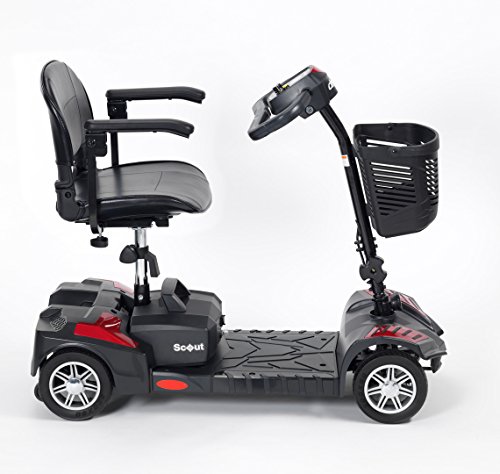
Four-wheeled mobility scooters offer extra stability and are perfect for use outdoors. Their turning radius is usually greater than that of a three-wheeled model, but they can be disassembled into smaller pieces for transport and storage.
Some four-wheeled models are lighter than their three-wheel counterparts and are available in a variety of sizes and weight limits. These scooters are great for those who travel a lot.
Four-wheeled configurations are also a good option for users who require mobility in their home or apartment. They can be maneuvered more easily and will fit better into small spaces than a tri-wheeled model.
A model with four wheels will have a higher clearance to the ground than a model with three wheels. This makes them a fantastic option for those looking to stay clear of obstacles such as rails or steps.
Mobility scooters that fold are an ideal choice for frequent travelers. They can be broken into light and portable pieces that allow them to store in airplanes or other large containers. They are also much cheaper than four-wheeled scooters. They come in a variety of designs and colors.
Dismantling
Mobility scooters that can be dismantled into multiple pieces are typically lighter and easier to transport. They are also easier to put together and disassemble which is particularly beneficial for those with less motor skills.
In addition, dismantling may be a great way to reduce the power consumption of batteries. The battery of a collapsible mobility scooter can be easily removed from the device to charge at home.
Certain models can be folded electronically by pressing a button. Some folding mobility scooters are heavier and are difficult to lift and fit into the trunk of a car. They also take a longer time to disassemble and assemble.
While dismantling isn't an essential feature of a foldable mobility scooter it can be beneficial to make sure the model you select has all the features required to make it simple to disassemble and assemble. This will save both time and money.
For instance the quingo Ultra is an excellent choice since it's fully portable and dismantleable. collapsible 4 wheel mobility scooter has a host of safety features, including adaptive footplates that allow for complete ergonomic posture control to reduce stress on the hips, back and knees.
Ground clearance
Look for a scooter with greater ground clearance for those who live in an area with rough terrain and have to navigate over bumps or curbs. This is crucial to avoid getting stuck in areas with little space, or even when you come across doors that are not be easy to climb over. collapsible disability scooters is also beneficial if your mobility scooter has full suspension that minimizes the amount of bumps you experience on your ride.
Generally speaking, scooters have between 1.5 to 4.5 inches of ground clearance, based on the model and the manufacturer. This is enough to avoid getting stuck on the ground, however when you intend to drive over rough surfaces like dirt, grass gravel, sand, or gravel you should look for an option with more ground clearance and all-terrain tires. Four-wheel scooters are perfect for outdoor use as they travel over rough terrain more easily than portable models for travel. They come with larger wheels to allow for easier maneuvering across obstacles of large size and also have more pneumatic tires which improves traction and decreases vibrations.